
A. 정부는 실거주 목적의 1주택과 실제 거주하지 않는 1주택 보유를 정책적으로 다르게 보려는 방향을 보이고 있습니다. 자기 집이 있으면서도 수도권에서 전세대출 보증을 활용하는 경우는 실수요 지원이라는 제도 취지와 어긋난다는 시각이 있습니다. 이런 구조가 반복되면 전세시장과 매매시장 모두에 왜곡을 줄 수 있다는 우려도 제기됩니다. 그래서 이번 논의는 실거주 중심으로 보증 제도를 다시 정비하려는 시도로 볼 수 있습니다.
티스토리 뷰
목차
반응형
📌 비거주 1주택자 전세대출 보증 제한 검토, 수도권 부동산 대책의 핵심은?
[New Housing Policy: Loan Guarantees Restricted]
최근 정부가 부동산 시장 안정 대책의 하나로 비거주 1주택자에 대한 수도권 전세대출 보증 제한 방안을 검토하면서 시장의 관심이 커지고 있습니다. 이번 논의는 실거주 목적이 아닌 주택 보유를 줄이고, 공적 보증이 실수요자 중심으로 작동하도록 방향을 재정비하려는 흐름 속에서 등장했습니다. 다만 현재는 세부안이 확정된 단계가 아니라 검토 단계인 만큼, 실제 적용 대상과 예외 기준, 시행 시기 등은 앞으로 달라질 수 있습니다. 따라서 이번 이슈는 단순한 대출 규제보다 정부의 부동산 정책 방향이 어디로 향하는지를 보여주는 신호로 볼 수 있습니다.
Recently, the government has been considering a plan to restrict Jeonse loan guarantees in the Seoul metropolitan area for homeowners who own one property but do not live in it. This proposal, introduced as part of broader measures to stabilize the real estate market, has drawn growing attention from the market. The discussion reflects an effort to reduce housing ownership that is not intended for actual residence and to ensure that public loan guarantees are primarily directed toward genuine homebuyers and tenants who need housing support. However, the policy is still under review and has not yet been finalized. As a result, details such as the exact target group, possible exemptions, and the timing of implementation may change in the future. Therefore, this issue can be seen not merely as a loan regulation but as a signal indicating the broader direction of the government’s real estate policy.
✅ 중요한 3가지 핵심
1) 이번 논의의 중심은 ‘비거주 1주택’ 규제 강화입니다
요약 정부가 검토 중인 전세대출 보증 제한은 모든 1주택자를 일괄 규제하려는 방향이라기보다, 자기 집에 살지 않으면서 수도권·규제지역에서 전세대출 공적보증을 활용하는 비거주 1주택자에 초점이 맞춰져 있습니다. 이는 실거주 목적의 정책 지원과 투자성 보유를 구분하려는 시도로 볼 수 있습니다. 최근 부동산 정책은 단순히 주택 수보다 실제 거주 여부를 더 중요하게 보는 흐름을 보이고 있습니다. 결국 이번 논의는 실거주 중심 정책 전환의 연장선에 있다고 해석할 수 있습니다.
The government’s proposed restriction on Jeonse loan guarantees is not intended to uniformly regulate all homeowners with a single property. Instead, the focus is on non-resident homeowners who own one home but do not live in it while using public Jeonse loan guarantees in the Seoul metropolitan area or other regulated regions. This approach can be seen as an attempt to distinguish between policy support intended for actual residence and housing held primarily for investment purposes. Recent real estate policies have increasingly emphasized whether a person actually lives in the property rather than simply the number of homes they own. Ultimately, the current discussion can be interpreted as part of a broader shift toward policies centered on real residence.
The government’s proposed restriction on Jeonse loan guarantees is not intended to uniformly regulate all homeowners with a single property. Instead, the focus is on non-resident homeowners who own one home but do not live in it while using public Jeonse loan guarantees in the Seoul metropolitan area or other regulated regions. This approach can be seen as an attempt to distinguish between policy support intended for actual residence and housing held primarily for investment purposes. Recent real estate policies have increasingly emphasized whether a person actually lives in the property rather than simply the number of homes they own. Ultimately, the current discussion can be interpreted as part of a broader shift toward policies centered on real residence.
Q.1 왜 비거주 1주택자가 규제 논의의 핵심이 되나요? 답변 보기
Q.2 이번 조치는 이미 확정된 정책인가요? 답변 보기
A. 아직은 아닙니다. 현재까지 알려진 내용은 정부와 금융당국이 관련 방안을 검토하고 있으며, 구체적인 대상과 방법은 확정되지 않았다는 수준입니다. 따라서 실제 시행 여부와 내용은 향후 발표에 따라 달라질 수 있습니다. 지금 단계에서는 확정 정책으로 단정하기보다 검토 중인 방향으로 이해하는 것이 더 정확합니다.
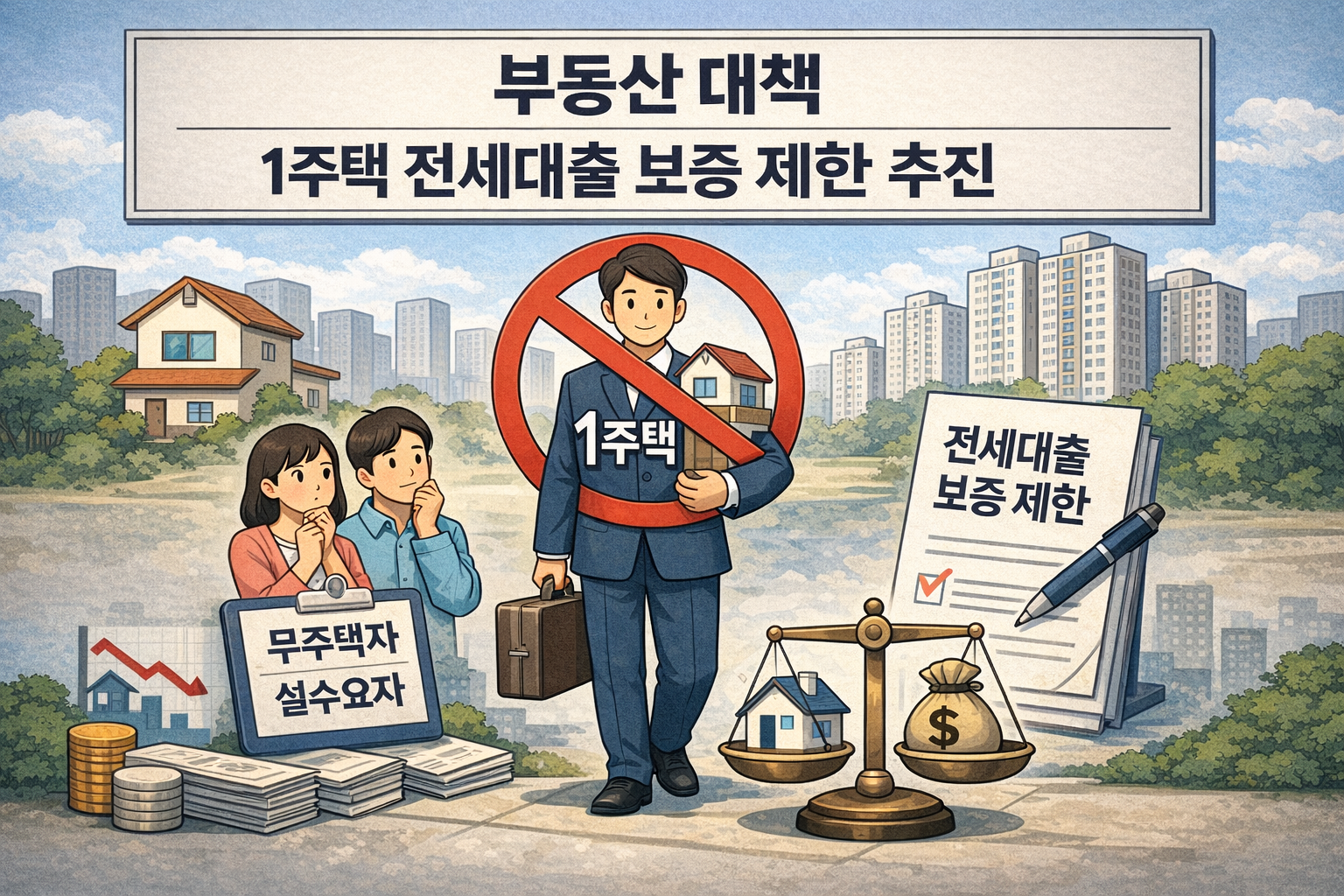
수도권 주택시장과 전세대출 보증 제한 논의를 상징하는 이미지
2) 전세대출 보증 제한 논의는 시장 안정과 정책 형평성을 겨냥합니다
요약 전세대출 보증 제한 검토의 목적은 단순히 대출을 줄이려는 데 있지 않고, 공적 보증이 실제 주거가 필요한 계층에게 더 집중되도록 하려는 데 있습니다. 비거주 1주택자의 보증 이용을 줄이면 무주택자나 실수요자 중심으로 제도 운영이 재편될 가능성이 있습니다. 또한 시장에서 비정상적인 수요를 줄이면 전세가격과 매매가격의 불안정성을 완화하는 효과도 기대할 수 있습니다. 결국 이번 논의는 전세시장 형평성과 정책 신뢰를 함께 높이려는 방향으로 볼 수 있습니다.
The purpose of reviewing restrictions on Jeonse loan guarantees is not simply to reduce lending, but to ensure that public guarantees are more focused on those who genuinely need housing support. By limiting the use of loan guarantees by non-resident homeowners with one property, the system could be reorganized to better serve households without homes and genuine housing demand. In addition, reducing abnormal or speculative demand in the market may help ease volatility in both Jeonse prices and housing sale prices. Ultimately, this discussion can be seen as an effort to improve fairness in the Jeonse market while also strengthening trust in housing policies.
The purpose of reviewing restrictions on Jeonse loan guarantees is not simply to reduce lending, but to ensure that public guarantees are more focused on those who genuinely need housing support. By limiting the use of loan guarantees by non-resident homeowners with one property, the system could be reorganized to better serve households without homes and genuine housing demand. In addition, reducing abnormal or speculative demand in the market may help ease volatility in both Jeonse prices and housing sale prices. Ultimately, this discussion can be seen as an effort to improve fairness in the Jeonse market while also strengthening trust in housing policies.
Q.1 전세대출 보증 제한이 왜 필요하다는 의견이 나오나요? 답변 보기
A. 공적 보증이 붙는 전세대출은 본래 실수요자의 주거 안정을 돕기 위한 성격이 강합니다. 그런데 비거주 목적의 1주택자가 이를 활용하면 제도 취지와 어긋난다는 비판이 나올 수 있습니다. 정부는 이런 부분을 줄여 실제 주거가 필요한 계층에 보증이 더 가도록 하려는 방향을 검토하는 것으로 보입니다. 이는 시장 형평성과 정책 신뢰를 높이는 데도 의미가 있습니다.
Q.2 실수요자에게는 어떤 영향이 있을 수 있나요? 답변 보기
A. 실거주 수요 중심으로 정책이 재편되면 무주택자나 실수요자에게는 상대적으로 더 유리한 환경이 조성될 수 있습니다. 비거주 목적의 수요가 줄어들면 전세시장 내 경쟁 강도나 가격 부담이 일부 완화될 가능성도 있습니다. 다만 실제 효과는 적용 범위와 예외 기준, 시장 반응에 따라 달라질 수 있습니다. 그래서 정책 발표 뒤 세부 내용을 꼼꼼히 확인하는 것이 중요합니다.
3) 향후 관건은 예외 기준과 정책의 정교함입니다
요약 정부가 비거주 1주택자 규제를 검토하더라도 부모 봉양, 직장 이동, 자녀 교육 같은 실수요 예외를 어떻게 다룰지가 중요합니다. 과거 전세대출 관련 규제에서도 실수요 예외 조항이 함께 운영된 만큼, 이번에도 현실에 맞는 예외 설계가 핵심이 될 가능성이 큽니다. 정책은 강도만 높다고 좋은 것이 아니라 실제 생활 여건을 반영해야 시장과 국민의 수용성을 얻을 수 있습니다. 결국 성공적인 정책 운영을 위해서는 지속적인 모니터링과 세부 기준 보완이 함께 이뤄져야 합니다.
Even if the government proceeds with regulations targeting non-resident homeowners with one property, it will be important to determine how exceptions for genuine housing needs—such as caring for parents, job relocation, or children’s education—will be handled. In previous regulations related to Jeonse loans, exceptions for real housing needs were also included. Therefore, designing practical and realistic exceptions is likely to be a key part of this policy as well. A policy is not effective simply because it is strict; it must also reflect real-life circumstances in order to gain acceptance from both the market and the public. Ultimately, successful policy implementation will require continuous monitoring along with adjustments and refinements to detailed guidelines.
Even if the government proceeds with regulations targeting non-resident homeowners with one property, it will be important to determine how exceptions for genuine housing needs—such as caring for parents, job relocation, or children’s education—will be handled. In previous regulations related to Jeonse loans, exceptions for real housing needs were also included. Therefore, designing practical and realistic exceptions is likely to be a key part of this policy as well. A policy is not effective simply because it is strict; it must also reflect real-life circumstances in order to gain acceptance from both the market and the public. Ultimately, successful policy implementation will require continuous monitoring along with adjustments and refinements to detailed guidelines.
Q.1 1주택자라도 예외가 인정될 가능성은 있나요? 답변 보기
A. 가능성은 있습니다. 과거 전세대출 제한 제도에서도 직장이동, 부모봉양, 자녀교육 같은 사유에 대해서는 예외가 인정된 사례가 있었습니다. 이번에도 정부가 실수요와 투자성 수요를 구분하려는 만큼, 일률적인 제한보다는 예외 기준을 둘 가능성이 큽니다. 핵심은 제도가 얼마나 현실적으로 설계되느냐에 달려 있습니다.
Q.2 앞으로 부동산 정책은 어떤 방향으로 이어질 가능성이 있나요? 답변 보기
A. 최근 정책 흐름을 보면 ‘실거주 중심 지원 강화’가 핵심 방향으로 보입니다. 주택 보유 수만 따지기보다 실제 거주 여부와 주거 필요성을 기준으로 금융·보증 제도를 재정비하려는 움직임이 이어지고 있습니다. 앞으로는 전세대출 보증뿐 아니라 주담대, 세제, 보증 정책 등이 함께 조정될 가능성도 있습니다. 결국 장기적으로는 실수요 중심의 주택 정책 체계를 더 정교하게 구축하려는 방향으로 이해할 수 있습니다.
👇👇
다주택양도세 중과종료***
주거개선필요성 및 청년주택
위 버튼 누르시면 신청 홈페이지로 이동합니다
🧾 결론
핵심 결론 정부가 검토 중인 비거주 1주택자 전세대출 보증 제한 논의는 단순한 금융 규제가 아니라 실거주 중심으로 부동산 정책의 방향을 재정비하려는 흐름 속에서 이해할 필요가 있습니다. 이는 공적 보증의 혜택이 실제 주거가 필요한 계층에 더 집중되도록 하고, 전세시장과 매매시장의 왜곡을 줄이려는 목적을 담고 있습니다. 다만 현재는 확정 단계가 아니기 때문에 실제 적용 대상과 예외 기준, 시행 방식은 향후 발표에 따라 달라질 수 있습니다. 정책의 효과를 높이기 위해서는 강도 높은 규제뿐 아니라 현실에 맞는 예외 설계와 시장 모니터링, 국민과의 소통이 함께 이뤄져야 합니다. 앞으로는 정책 발표 이후 구체적인 세부안을 꼼꼼히 살펴보며 실수요자 보호와 시장 안정이라는 두 목표가 어떻게 조화되는지 지켜볼 필요가 있습니다.
The government’s review of restrictions on Jeonse loan guarantees for non-resident homeowners with one property should be understood not merely as a financial regulation, but as part of a broader effort to realign real estate policy toward actual residence. The policy aims to ensure that the benefits of public loan guarantees are more focused on people who genuinely need housing, while also reducing distortions in both the Jeonse rental market and the housing sales market. However, since the policy has not yet been finalized, the specific target groups, exemption criteria, and implementation methods may change depending on future announcements. To enhance the effectiveness of the policy, it will be important not only to introduce strong regulations but also to design realistic exceptions, conduct continuous market monitoring, and maintain open communication with the public. Going forward, it will be necessary to carefully review the detailed measures announced later and observe how the two goals—protecting genuine housing demand and stabilizing the market—are balanced.
The government’s review of restrictions on Jeonse loan guarantees for non-resident homeowners with one property should be understood not merely as a financial regulation, but as part of a broader effort to realign real estate policy toward actual residence. The policy aims to ensure that the benefits of public loan guarantees are more focused on people who genuinely need housing, while also reducing distortions in both the Jeonse rental market and the housing sales market. However, since the policy has not yet been finalized, the specific target groups, exemption criteria, and implementation methods may change depending on future announcements. To enhance the effectiveness of the policy, it will be important not only to introduce strong regulations but also to design realistic exceptions, conduct continuous market monitoring, and maintain open communication with the public. Going forward, it will be necessary to carefully review the detailed measures announced later and observe how the two goals—protecting genuine housing demand and stabilizing the market—are balanced.
반응형